Want to bring distant things closer without carrying an armful of glass and weighty promises?
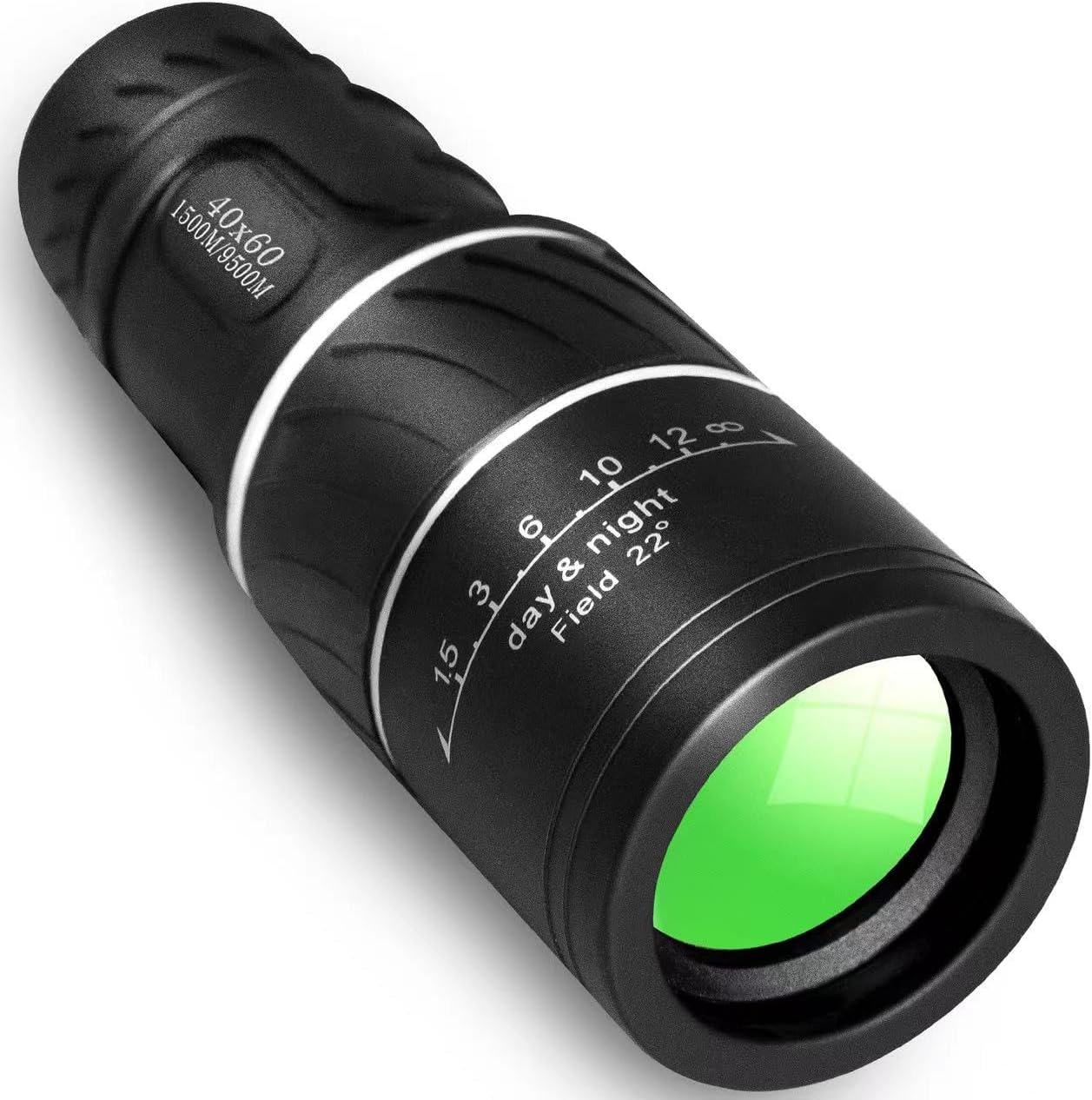

Product overview: Monocular Telescope, Upgrade 40 x 60 Portable Telescope, Monoculars for Adults High Powered, Suit Stargazing, Hunting, Bird Watching, Hiking Travel, Camping, Black
You’re holding a name that reads like a wish list and a specification sheet had a baby. The listing calls it an upgrade, portable, high powered — and suited to stargazing, hunting, bird watching, hiking, travel, and camping. You should read that and expect versatility, but also expect marketing language that stretches a little.
You’ll notice two competing claims in the description: a 10x magnification in the “About this item” and a name that suggests 40 x 60 power. That mismatch invites you to pause and check what’s actually in the box. Always verify the exact model specs from the seller before you commit, because magnification and objective diameter determine what you can actually see.
What the listing actually says
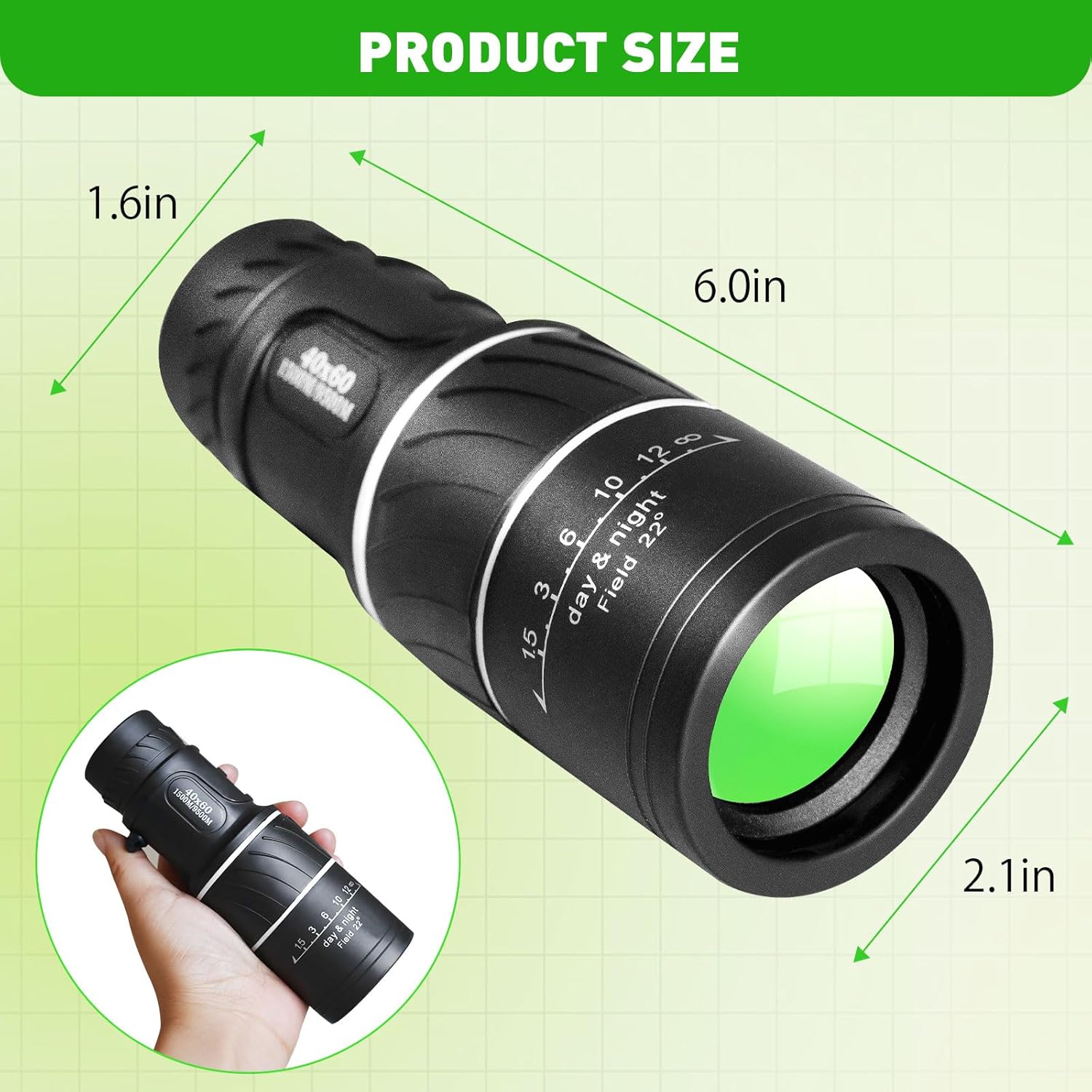
The product text gives you a few hard numbers and a few claims: 10x magnification, a length of 15.2 inches, a big lens diameter of 5.4 inches, a small lens diameter of 4.0 inches, and construction from metal mirror barrel with rubber exterior. It also promises waterproof and moisture-proof performance. Those are solid-sounding points, but they demand scrutiny. The dimensions sound exaggerated for a pocket monocular, so you’ll want to confirm measurements and the precise magnification.
How to treat the specs
Trust the numbers that are consistent across multiple sources and question the ones that aren’t. You’ll learn to read product pages like a map that sometimes leads you to treasure and sometimes to a swamp. Verify magnification, verify lens diameter, and check whether a tripod or phone adapter is included if you plan to photograph through the lens.
Key specifications table
You like a quick glance. Here’s a simple table that breaks down the seller-provided details and the notes you should keep in mind. Use it like a cheat sheet before buying.
| Feature | Seller-stated value | Notes for you |
|---|---|---|
| Product name | Monocular Telescope, Upgrade 40 x 60 Portable Telescope, Monoculars for Adults High Powered, Suit Stargazing, Hunting, Bird Watching, Hiking Travel, Camping, Black | Long marketing name; implies 40x magnification and 60mm objective, but verify. |
| Magnification | 10x (stated under About this item) | Conflicts with product name; check seller’s technical specification. 10x is stable hand-held; 40x needs support. |
| Length | 15.2 in | Very large for a pocket monocular; confirm—might be listed in cm or be product packaging size. |
| Big lens diameter | 5.4 in | Unusually large; likely a listing error. If true, this would be huge and heavy. |
| Small lens diameter | 4.0 in | Also large; verify. |
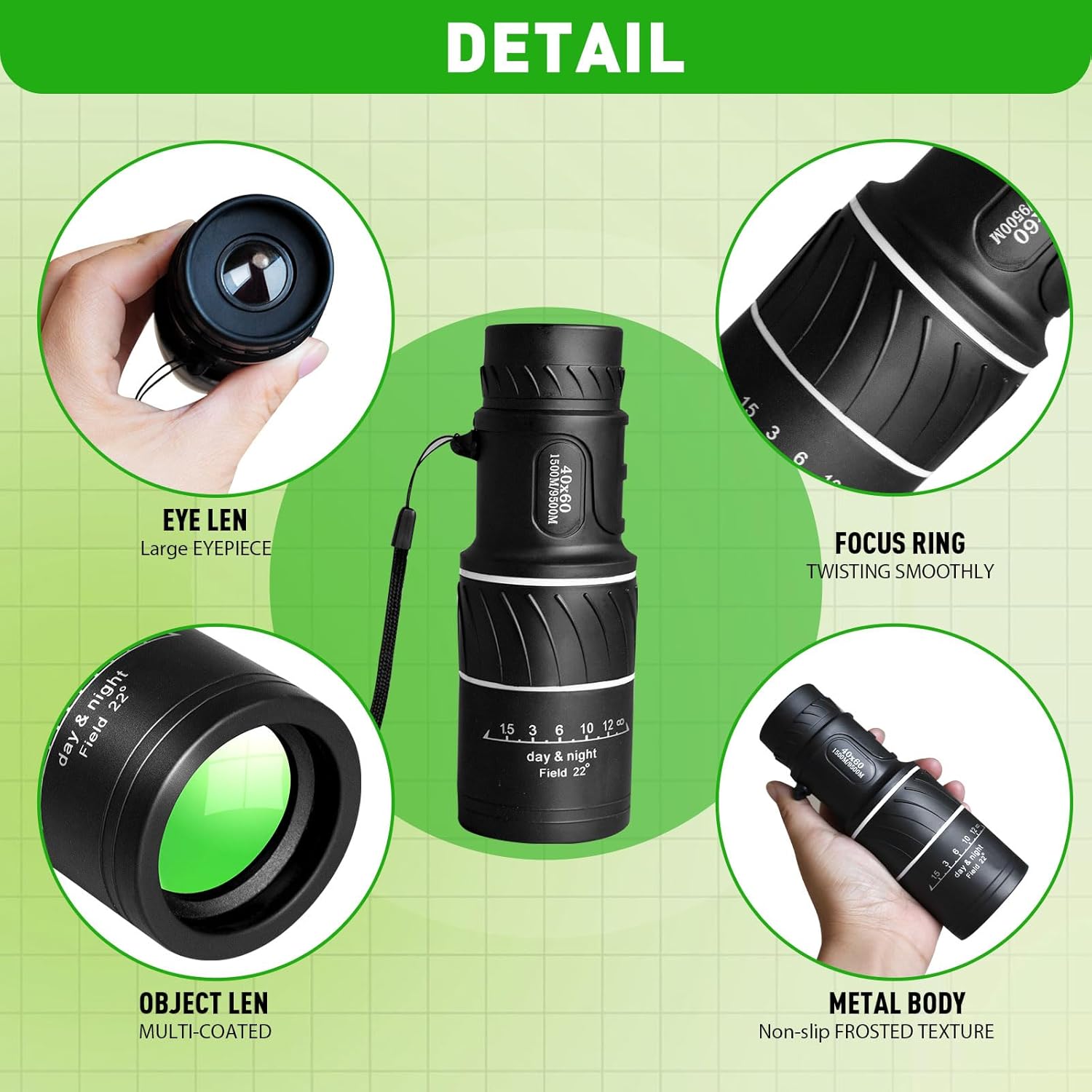
| Body material | High quality metal mirror barrel; outer rubber material | Solid claim; metal body with rubber coating helps grip and durability. |
| Weather resistance | Waterproof and moisture-proof; highly airtight fuselage | Useful for outdoor use; still confirm IP rating if you need full submersion protection. |
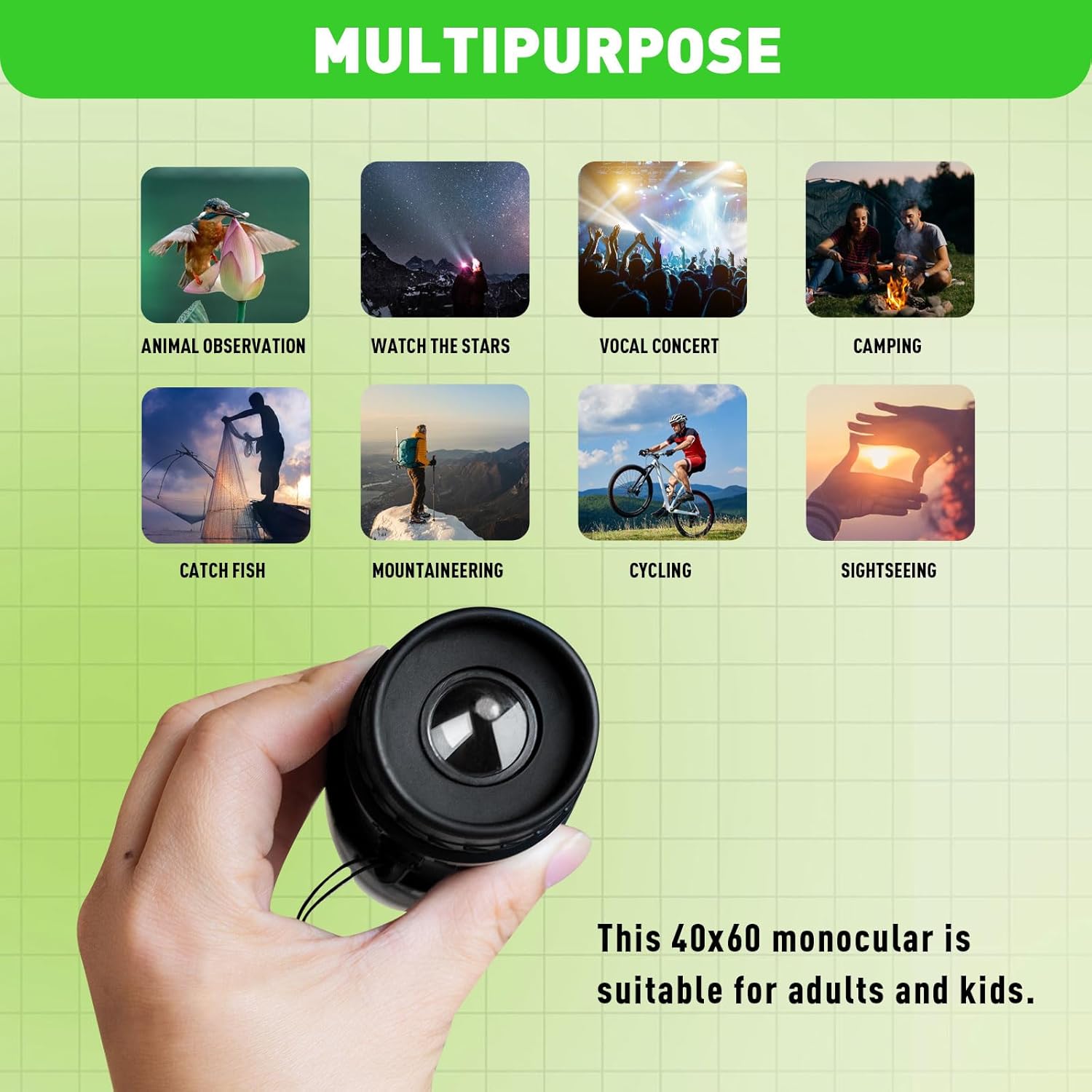
| Use cases | Stargazing, hunting, bird watching, hiking, travel, camping, concerts, tours, ball games, scenic views | Versatile list; effective performance will depend on true magnification and optics quality. |
| Smartphone compatibility | Mentioned as “monocular telescope for smartphone” | Likely compatible with phone adapters, but confirm whether adapter is included. |

Build quality and materials
You want a tool that can survive a trail, a pocket, a rainstorm, and your occasional clumsiness. The listing talks about a metal mirror barrel and a rubber exterior, and that already tells you the manufacturer had survival in mind.
The metal barrel gives the impression of precision and weight. The rubber coating does the work of making the thing grippable and more forgiving when you fumble it from a fence post or a cooler lid. If it feels cheap in your hands, you’ll know why: finish and fit matter more than the claim itself.
Feel and ergonomics
Hold one in a real store if you can, or read hands-on reviews. The rubber should be tacky, not greasy. Buttons or focusing rings should move smoothly, not with a gritty hesitation. You want the seal between metal and rubber to be neat, because rough seams are where water and grit start to live.
You’ll notice where the eye cup finishes and the body begins. A softer eye cup is nicer for long viewing sessions; a hard rim can be irritating. If you wear glasses, check the eye relief — the distance your eye needs to be from the lens. No one writes eye relief on sublimely ambiguous marketing paragraphs, but you can find it in the detailed spec sheet or user manual.
Durability and weatherproofing
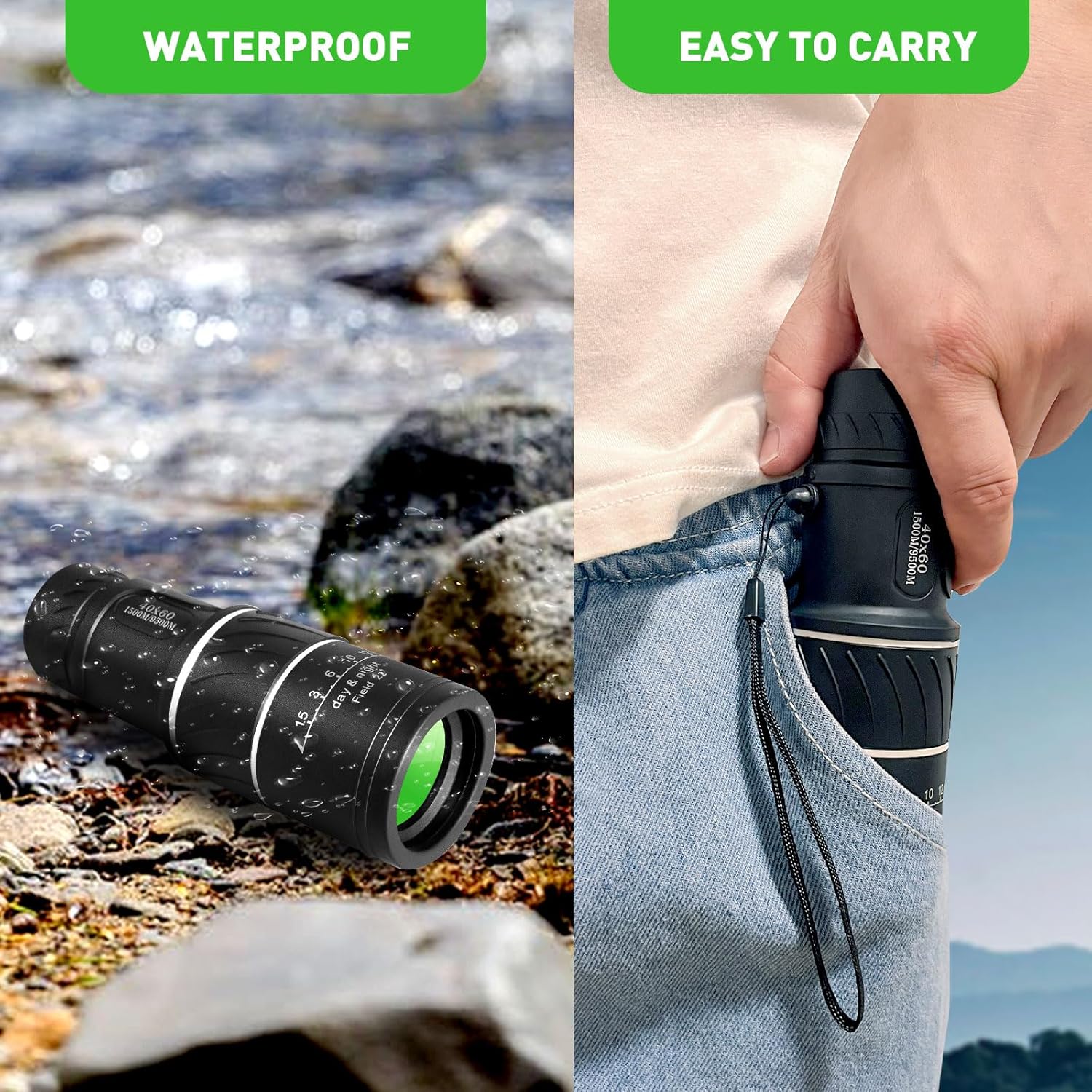
The listing promises waterproof and moisture-proof construction. That’s a good baseline. In practice, you’ll want to know if it’s simply rain-resistant or rated to be submerged. Gear that’s “waterproof” without an IP rating may withstand drizzle and accidental splashes, but not a river dip.
Rubberized bodies help protect against knocks; metal barrels help with rigidity. The seals, the thread quality on any mounts, and the strength of any included tripod mount are where long-term durability lives or dies. Inspect those if you can, and ask the seller about warranty and return policies before you buy.
Size and portability
You probably carry this for half a day, sometimes all day. The seller wrote a length of 15.2 inches and lens diameters of 5.4 and 4.0 inches. If those numbers are correct, you’re carrying something closer to a small spotting scope than a pocket monocular.
If you want lightweight and pocketable, you want something that slips into a jacket pocket or a small daypack compartment. If the product truly matches the seller’s oversized dimensions, it’ll be less pocketable and more “strap to your pack” territory. Know what you want before you buy.
What to expect on hikes and travel
On a trail you want balance: reach and magnification versus weight and fatigue. A heavier monocular nags at your hands and shoulders. A light, shorter one invites spontaneous use — you’re more likely to glance, to point, to buy a moment. If your journeys include long views from ridgelines or late-night sky watching, you’ll also want a tripod. Higher magnifications demand stability.
Carrying and storage
A hard or semi-hard case will make a difference if you’re tossing it in a bag with keys and a water bottle. Many sellers include nylon pouches or shoulder straps. If your seller does not, budget for a case. Keep lens caps or covers with you; uncovered lenses pick up scratches and grease like magnets.
Optical performance
Now you’ll ask the crucial question: what will you actually see? That answer depends on magnification, objective diameter, lens coatings, and the alignment inside the tube. The product name hints at bold optics; the “About this item” offers a more modest 10x. Both ideas create different expectations.
Magnification tells you how much nearer the subject appears; objective diameter tells you how much light the lens can gather. A 10x with a 60mm objective can be bright and manageable by hand. Forty times magnification asks for a tripod and a steady heart. If your sky-watching or long-range wildlife observation relies on detail, the combination of optics and stability matters far more than a marketing number.
Magnification: the practical truth
If it’s truly 10x, you’ll enjoy a steady, handheld image with minimal shake. You’ll follow birds in flight more easily and scan a scene without a tripod. If it’s 40x, the world becomes a thin slice and your hands become the enemy; stars and distant birds will require a tripod and an expert’s patience.
You shouldn’t be seduced by larger numbers. High magnification sounds like superhero powers until you try to hold them steady. The image might be narrower and dimmer, and chromatic aberrations or edge softness will become more obvious. Ask yourself whether extreme magnification will help you or just complicate your outings.
Brightness, contrast, and coatings
Brightness comes from the objective diameter and the quality of the glass. Coatings on the lenses reduce glare and increase contrast. The seller’s note about a “high quality metal mirror barrel” suggests an internal reflection design that hopes to preserve image fidelity, but it’s the glass and coatings that do the real work.
If the monocular uses multi-coated or fully multi-coated optics, you’ll get better light transmission and crisper colors in low light. If coatings are absent or minimal, images will look flat and washed out when the sun drops. For stargazing and dawn/dusk birding, coatings matter.
Focusing and stability
You want to know how quickly you can bring a distant point into clarity. A smooth focus wheel with a wide range lets you lock onto targets quickly and maintain focus as distances change. Some units use twist-focus eyepieces or sliding mechanisms; others use a central wheel. Your preference will be visceral: you’ll know whether the action feels solid and precise or loose and vague.
For high magnifications, stabilization is non-negotiable. A tripod mount or a solid adapter changes the experience from shaky to cinematic. Without a mount, 40x is a challenge; 10x you can live with in your hands.
Focusing mechanism in everyday use
A good focusing ring will be firm but not stiff, with a predictable ratio of rotation to focus shift. If it’s too fast, you’ll overshoot your target; too slow and you’ll lose patience. You’ll appreciate a detent or a tactile click near infinity for quick star checks. In standard practice, you’ll spend most time fine-tuning, not sweeping.
Tripod mounting and attachments
If you plan to use higher magnifications or photograph through the eyepiece, you’ll want a stable mount and perhaps a smartphone adapter. Some sellers include a small tripod; others don’t. If a tripod is absent, pair the monocular with a compact tripod that can hold it steady. A universal adapter helps you capture images with your phone, but alignment and exact fit matter more than the advertising shot.
Smartphone compatibility and photography
You may want to turn the monocular into a lens for your phone. The product text mentions “Monocular telescope for smartphone,” which implies compatibility. That’s a useful feature if you intend to share close-up views of birds, game, or the moon.
But don’t expect DSLR-level sharpness. When you point a phone camera through a monocular, you’re aligning two optical systems. The result depends on the adapter quality, the steadiness of your setup, and the phone’s camera sensor. With care, you’ll get pleasing images of distant objects and good moon shots; without care, your photos will look like they were taken through a tremor.
Tips for better smartphone photos
Place the phone camera lens exactly over the eyepiece, use a stable mount and tripod, and use the phone’s tap-to-focus feature on the subject. Reduce digital zoom on your phone to avoid additional noise. Turn on image stabilization if your setup allows. Bright scenes or moon shots will reward you more than low-light wildlife at dawn unless you have a very steady mount.
Video through a monocular
Recording video requires the same alignment and stability as stills. Small movements become big when magnified. Expect jerky footage without stabilization. If you’re serious about video, invest in a tripod and a fluid head for smoother pans.
Use cases: how it performs in real-life activities
You want to know whether this monocular suits the life you lead. The product names suggest it’s for stargazing, hunting, bird watching, hiking, travel, and camping. Each activity has different demands, and one optic rarely does everything perfectly.
Stargazing
If the monocular truly offers a large objective and clean coatings, you can do casual lunar observations and bright star clusters. For planetary detail or deep-sky objects, you’ll be limited. Stargazing rewards aperture and darkness more than magnification alone. If the unit is 10x and has a larger objective, you’ll enjoy wide-field views and bright images of the moon and star clusters.
Bird watching
For birds you want quick acquisition and a stable image. A 10x handheld monocular is ideal for this: you’ll track active birds without a tripod and still see detail. If the unit is 40x, you’ll need a tripod for anything other than perched birds, which reduces spontaneity.
Hunting
Hunters value ruggedness, quick focus, and reliability. Inclement weather, dirt, and fast-moving targets make a durable, compact optic more useful than an ultra-high-power one. If this monocular is as weatherproof and tough as it claims, it can be a good scouting tool. You’ll prefer lower magnification for faster target acquisition.
Hiking and travel
You want something you’ll actually use between viewpoints. Portability is king. If the dimensions turn out to be smaller and pocketable, the monocular can become a constant companion. If it’s as large as the seller’s measurements suggest, you’ll strap it to a pack and use it less often.
Camping and general scenic views
Camping benefits from a generalist optic — one that gives you good sunrise views, star checks, and perhaps a close look down the valley. Expect pleasant performance for casual viewing of landscapes and the moon. For serious astronomy or precise long-range reconnaissance, pair it with a tripod and temper your expectations.
Pros and cons
You like lists. They give structure to indecision and a place to land.
Pros
- Promised durability: metal barrel and rubber exterior suggest a tough build, which you’ll appreciate in the outdoors.
- Claimed weather resistance: waterproofing and airtight fuselage mean you can use it in less-than-ideal conditions.
- Versatility in advertising: marketed for many activities, so it’s positioned as an all-purpose tool.
- Possible smartphone compatibility: if present and well-designed, you can capture distant scenes with your phone.
Cons
- Conflicting magnification specs: the product name suggests 40×60, but the item details say 10x. That discrepancy demands verification.
- Questionable size figures: lengths and diameters listed sound large for a pocket monocular and might be errors.
- Potential for shaky images at high magnification: if the monocular is actually 40x, you’ll need a tripod.
- Unclear accessory inclusion: many buyers expect tripods and phone adapters; confirm what’s boxed.
Comparison to alternatives
You’ll want to compare this to pocket monoculars, binoculars, and spotting scopes. Each class has trade-offs.
- Pocket monoculars: smaller, lighter, easier to carry. They will generally be lower in aperture and magnification, but they’re more likely to be used because they’re always at hand.
- Binoculars: offer depth perception and easier tracking of moving subjects. A 10×42 binocular is a classic field tool. If you need both eyes, look to binoculars instead.
- Spotting scopes: larger objectives, stronger magnification, and tripod use make these better for long-distance observation and astrophotography. They weigh more and are less portable.
Choose based on your priorities: portability and quick use argue for a small monocular or binoculars. Serious long-range viewing argues for a spotting scope on a tripod.
How to test it before you commit
If possible, try before you buy. If you can’t, look for the seller’s return policy and warranty. Check customer photos that show the monocular in hand, next to familiar objects, or in use on a tripod. Real photos will reveal how heavy it looks, whether the size claims are believable, and how crisp the edges appear.
Practical checks
- Confirm the exact magnification and objective diameter from the technical sheet.
- Ask whether a tripod, phone adapter, or case is included.
- Look for an IP rating or test reports for water resistance.
- Read multiple user reviews that mention long-term durability and optical quality.
Maintenance and care
You’ll treat it like a small instrument. Wipe lenses with lens tissue or a microfiber cloth. Avoid breathing directly on the glass to fog it purposely. Use a soft brush or a bulb blower for dust; lens fluid for smudges. Don’t over-tighten mount screws or force the focus ring. Keep it in its case when not in use, and check seals if you use it in salty or harsh environments.
Cleaning tips
Start with a blower, then a soft brush, then a microfiber cloth if you need to remove grease. Lens cleaner or alcohol-based solutions are fine in small amounts, but avoid ammonia-based cleaners which can damage coatings. Dry it thoroughly if it gets wet and open any battery or accessory compartments so moisture can evaporate.
Storage
Keep silica gel packets in the case to absorb moisture. If you store it long-term, check periodically for mold or fungus on lenses — optical fungus kills glass coatings if left unchecked. If you use it in winter, let it acclimate to room temperature before opening it, to avoid condensation inside.
Final verdict and who should buy it
Here’s the plain language: if the monocular is actually 10x with a decent objective and a solid build, you’ve got a great everyday companion for hikes, casual birding, sporting events, and a quick star-check. It’s the sort of tool that invites spontaneous use because it’s not a burden. If, instead, it truly is a 40×60 optic, you should buy it only if you plan on using a tripod and you crave long-distance viewing more than portability.
You’ll want this if:
- You want a single-lens, lighter-than-spotting-scope option for casual observation.
- You value ruggedness and weather resistance for outdoor use.
- You plan to use a tripod or already have one for higher magnifications.
- You like the idea of snapping distant photos with your smartphone through a monocular, and you confirm an adapter works or is included.
You should hesitate if:
- You need a guaranteed 40x magnification for hand-held use — that’s impractical without stabilization.
- You demand strict, push-button technical detail in the listing — this product’s marketing has fuzzy edges.
- You require full submersion waterproofing without an IP rating.
Bottom line
Treat the product listing like a conversation. Ask questions. Confirm measurements and magnification. If the unit is the 10x workhorse the item text suggests, you’ll have a loyal, portable optic that enhances travel, hikes, and casual stargazing. If it’s the larger 40×60 the name implies, know that it will demand a tripod, patience, and a willingness to trade portability for reach.
You’ll see sooner whether this monocular becomes a daily tool or a paperweight by checking those numbers and imagining it in your hands at dawn on a ridge, at dusk by a campfire, or on a quiet park bench watching a hawk. It’s not the camera of your eye; it’s an extension of your curiosity. Keep that in mind, and buy with a little skepticism and a lot of practical expectation.

Disclosure: As an Amazon Associate, I earn from qualifying purchases.