
Have you ever watched a tiny speck on a ridge turn into a hawk with the slow insistence of a revelation?

First impressions
You lift the Spotting Scope 25-75×85, Dual Focusing Spotting Scopes with BAK4 Prism & FMC Lens, Tripod, Phone Adapter and Carrying Case, Spotter Scope for targeting, Bird Watching, Wildlife, and it feels like a tool that expects work and will give answers. The body sits in your hands the way a well-read book sits on a shelf — substantial, slightly heavy, honest about its purpose.
You notice the objective lens first: 85mm, big enough to feel legitimate for low light and long-distance work. The casing, the eyepiece, the tripod mount — all of it telegraphs that this scope wants to be used outside, not just admired indoors.
Product overview
You’re looking at a spotting scope that promises versatility: 25x to 75x zoom, BAK-4 Porro prism, fully multi-coated optics, a two-speed focusing system, and weatherproofing with nitrogen purging. It comes with practical accessories — a tripod, phone adapter, and carrying case — so you don’t have to assemble a kit from spare parts.
The name is long because the product wants to reassure you it covers its bases. The real question is whether those features translate into reliable performance when you’re three miles from the nearest coffee shop and a flock of warblers has just materialized on a distant ridge.
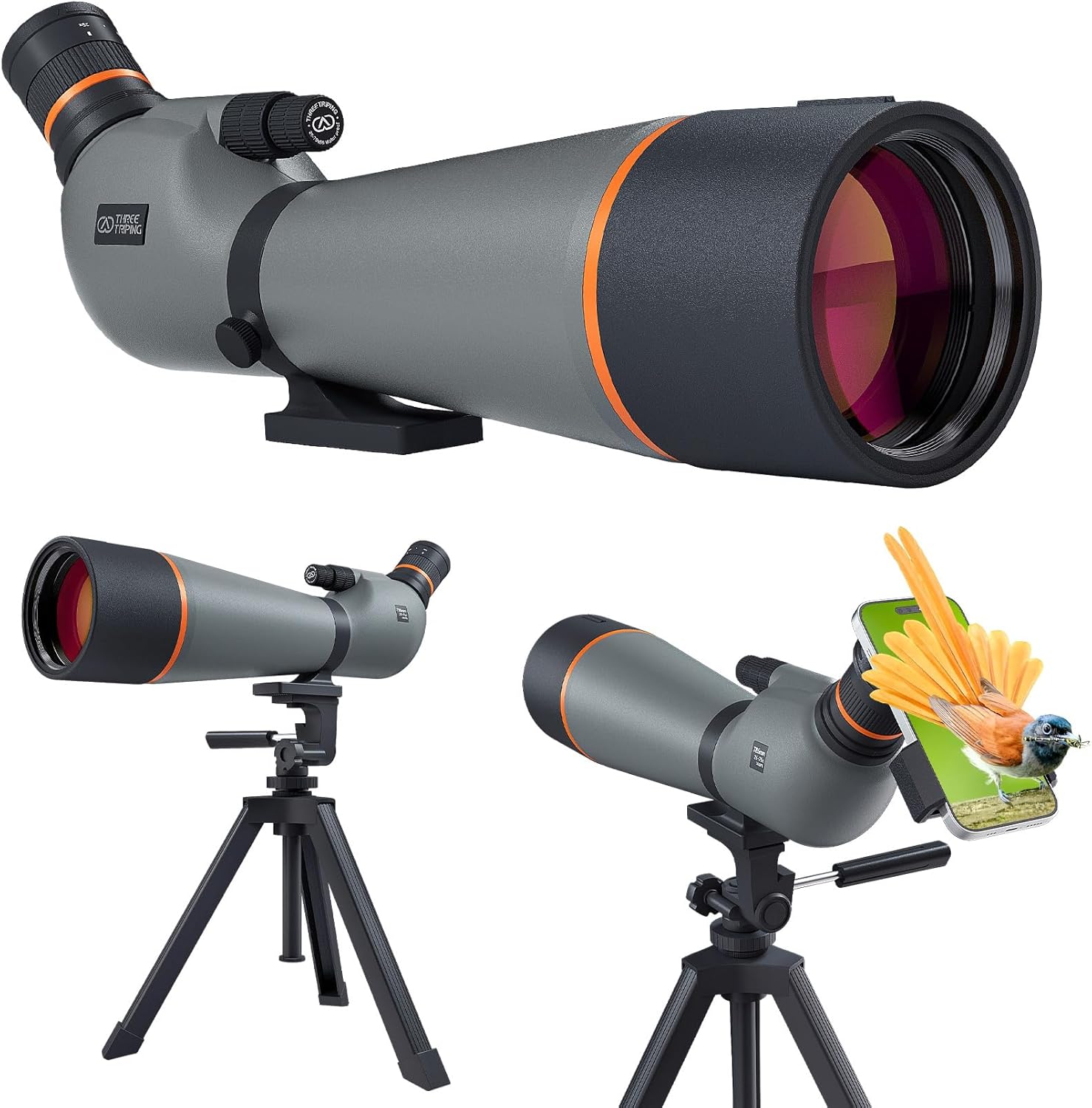

Key specifications (at a glance)
You appreciate a quick-reference table when decisions pile up and daylight is limited. This table breaks the essentials down into bite-sized, useful pieces so you can see what matters and why.
| Feature | Specification | Why it matters |
|---|---|---|
| Magnification | 25x — 75x | Covers wide-angle viewing to extreme detail for distant targets. |
| Objective Lens | 85 mm | Larger objective collects more light for brighter images, especially at dawn/dusk. |
| Prism Type | BAK-4 Porro prism | Better edge-to-edge sharpness and light transmission than BK7 alternatives. |
| Lens Coating | Fully Multi-Coated (FMC) | Reduces reflections and increases contrast in challenging lighting. |
| Focus System | Coaxial two-speed (fast + fine) | Lets you lock on quickly and refine for critical detail. |
| Field of View | 42.5–88.5 ft / 1000 yds | Varies with zoom; lower magnification gives wider view useful for scanning. |
| Weatherproofing | Nitrogen-filled, O-ring sealed | Keeps moisture and dust out; reduces fogging across temperature changes. |
| Accessories | Tripod, phone adapter, carrying case | Enables stable viewing and digiscoping; eases transport. |
| Sunshade | Built-in | Cuts glare and protects objective during inclement weather. |
You can come back to this table when you’re packing or comparing specs against another scope on a forum at midnight. It’s the sort of sheet you pass to a friend and say, “Look: the essentials.”
Optical performance
You want a scope that gives you clarity, contrast, and the ability to hold an image in your mind after you lower it. Optical performance is the beating heart of any spotting scope, and this one centers its strengths on a wide zoom range and high-quality glass.
There will be trade-offs — every eyepiece is a compromise between magnification, light gathering, and stability — but this scope leans toward giving you flexibility. When you dial down to 25x you get a forgiving, bright field; when you push to 75x you get interrogative detail, but you also expose the limits of steadiness and atmospheric turbulence.
Magnification range: 25x to 75x
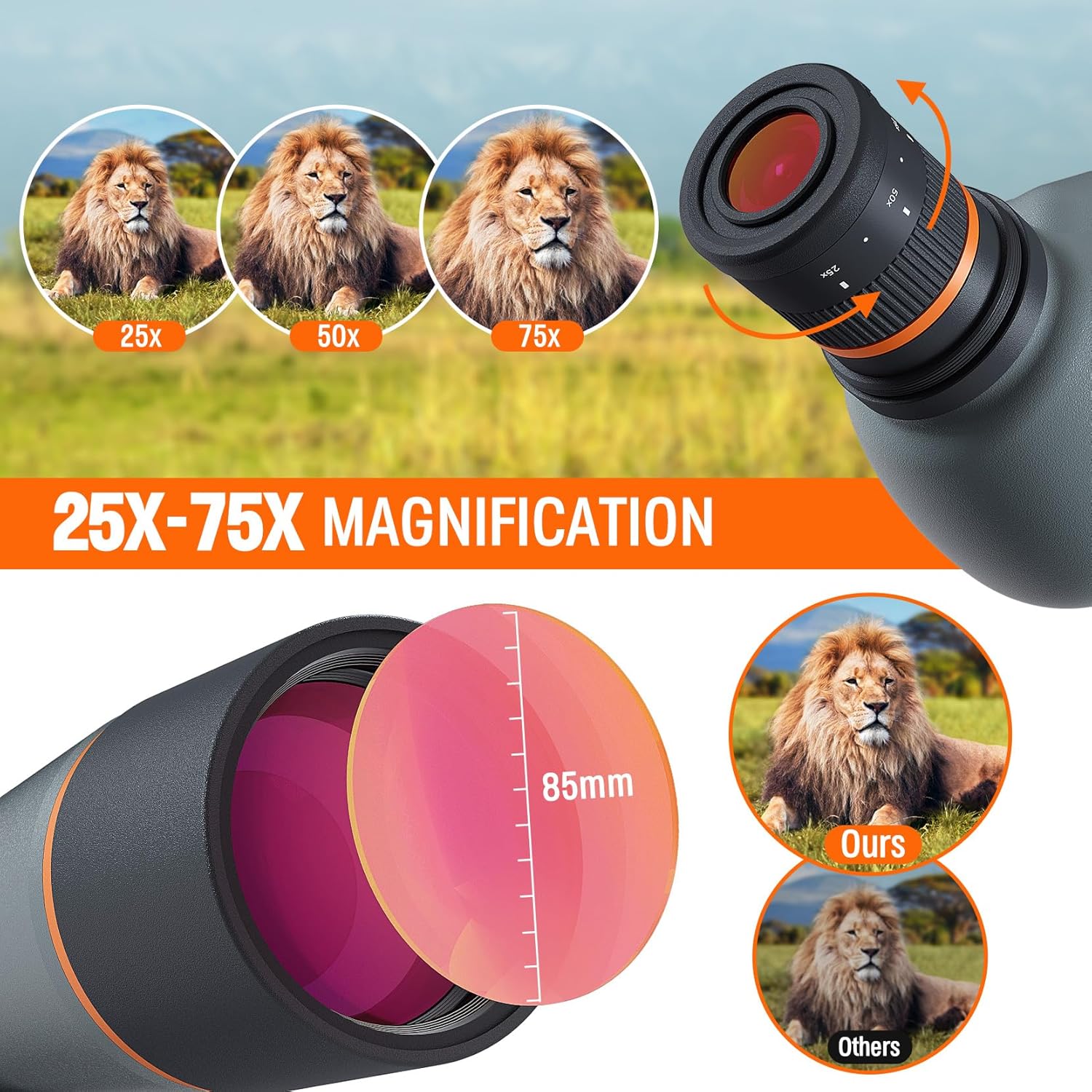
You can swing from a broad survey to a close-in inspection without changing oculars, which is a beautiful convenience in the field. That range makes the scope suitable for both scanning a treeline and picking out a target ring-by-ring.
At lower magnifications you’ll appreciate faster target acquisition and better image stability, especially when using the included tripod. At higher magnifications you must be patient with atmospheric shimmer and camera shake, and accept that maximum zoom is best used under still-air conditions or with a heavy tripod.
Field of view and image stability
You’ll notice the field-of-view numbers — 42.5 to 88.5 feet at 1000 yards — and the way they change with zoom. The wider end makes birding and scanning intuitive; the narrow end rewards you with detail if you can manage steadiness.
Image stability becomes the limiting factor the moment you pass about 60x. The included tripod helps, but you’ll also learn to use breathing, gentle hand placement, and a damped mount to temper the small shakes that turn high magnification into jitter.
Prism and lens coatings (BAK-4 & FMC)
You get a BAK-4 Porro prism and fully multi-coated lenses, and that matters in ways you’ll feel more than read about. BAK-4 glass improves edge clarity and light transmission; FMC coatings minimize reflections and help preserve contrast.
The combination produces images that feel less like they’re being projected through a tunnel and more like you’ve been allowed an unobstructed view. Colors resolve with fidelity, and shadows retain detail instead of collapsing into black.
Focusing system
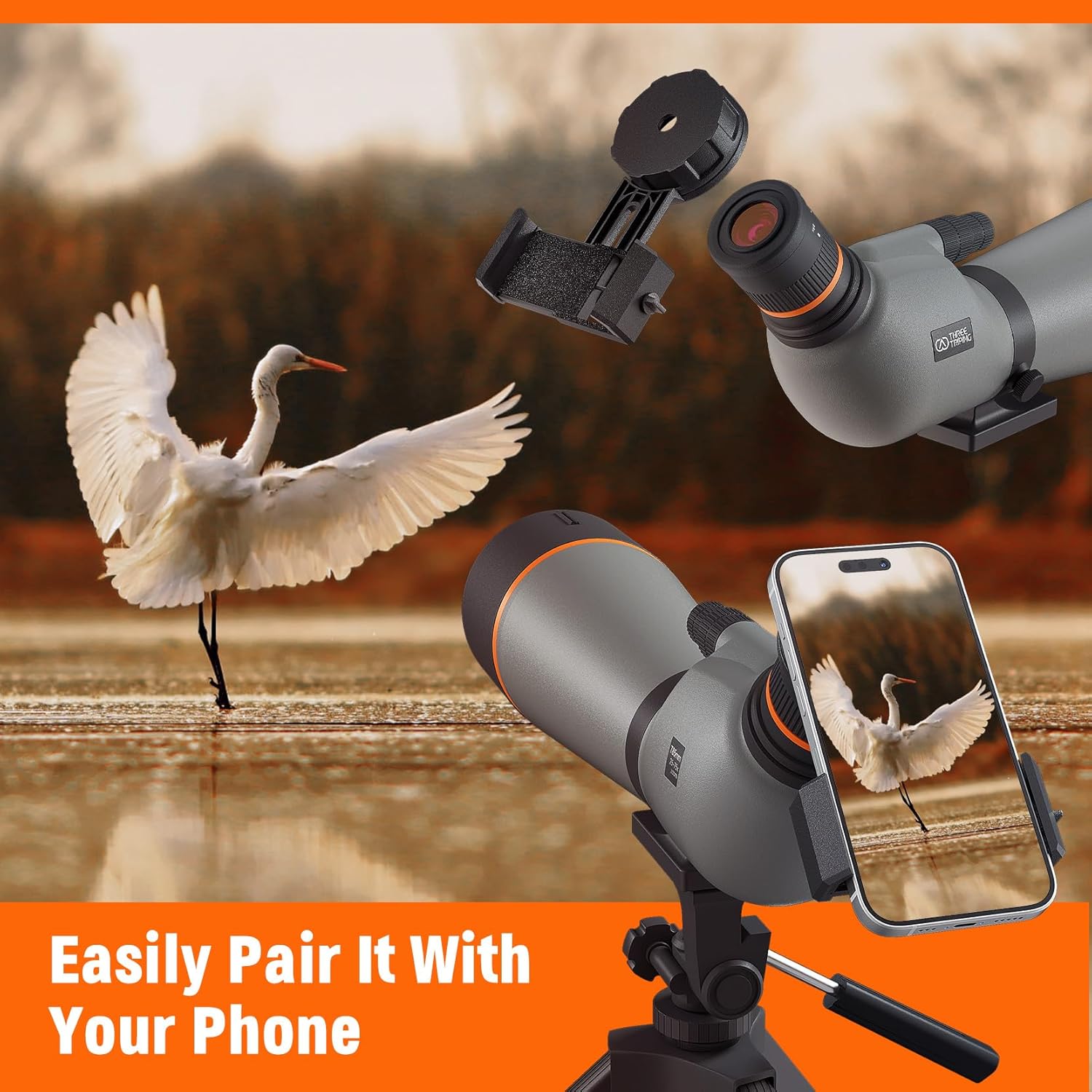
You’re given a dual-speed focus mechanism: fast focus to get on target, and fine focus to hold your attention there. That’s the sort of ergonomic design you start to miss the moment you try a single-speed alternative.
The coarse wheel brings things into general alignment quickly, saving you time when subjects move. The fine wheel lets you micro-adjust; it’s the difference between “I think that’s a deer” and “that’s a buck, rack three, clearly visible.”
Fast focusing
You’ll use the fast focus when a bird flicks from branch to branch or when a target appears suddenly on a range. It’s confident and direct, and it prevents you from losing the moment while fiddling.
Fast focusing is built for action: quick inputs, immediate results, the kind of muscle memory you develop on repeated mornings.
Fine focusing
Fine focusing is where patience pays off and where the scope rewards you for lingering. Small adjustments reveal feather barbs, the subtle wear on a shooting target, or the glint in an animal’s eye.
You’ll appreciate the tactile feedback on the fine wheel; it’s steady, predictable, and doesn’t jump when you whisper a correction.
Build quality and weather resistance
You’re carrying this scope into weather that will test its promises — wind, mist, the sun that drops out at dusk. The nitrogen purge, O-ring seals, and sturdy housing make the scope a field companion rather than a delicate instrument to be coddled indoors.
The built-in sunshade is a small but useful addition; it cuts glare and reduces rain strike on the objective. The materials feel durable without being clumsy, and the finish resists the scuffs you’ll inevitably collect on trails and ranges.
Nitrogen-filled and O-ring sealed design
You’ll find comfort in the knowledge that moisture and internal fogging are minimized. Nitrogen purging combined with O-ring seals helps the optics resist sudden temperature changes and damp conditions.
If you live somewhere that toggles daily between hot sun and cold fog, this design feature saves you time and frustration. It’s the kind of engineering that quietly lets you keep watching instead of fumbling with drying towels.
Built-in sunshade and exterior protection
The sunshade reduces stray light and helps preserve contrast when the sun sits low and mean in the sky. It also gives the front element a measure of protection from rain and dust.
You’ll be less worried about stray branches or a surprise wind if you don’t have to baby the objective lens; the sunshade acts like a sensible jacket for the glass.
Tripod and mounting
You’ll rarely get the most out of 75x without the stability of a rigid tripod, and this kit includes one that’s serviceable and straightforward. The tripod enables extended sessions where you can observe without cramping your shoulders or wobbling the view.
The included mount supports 360-degree rotation, which makes panning across a horizon simple and satisfying. If you’re moving between targets frequently, that rotation saves steps and keeps you rooted in the visual narrative.
Tripod head and 360-degree rotation
You’ll find the head’s rotation useful for following flight paths or scanning across an open plain. The panning is smooth enough to feel intentional rather than mechanical.
The trade-off is that, while the tripod is solid, it isn’t the same as a high-end beefy pro unit; if you plan on regular high-magnification use in wind, you might upgrade. For most users, though, this tripod strikes a sensible balance between portability and steadiness.
Stability and portability balance
You’ll notice that lighter tripods are easier to carry but less stable; this included tripod leans toward portability while still delivering respectable steadiness. For roadside hunts, birding along trails, or archery practice, it’s more than adequate.
If you’re packing for a long backcountry move you’ll appreciate the tripod’s relative lightness. If you’re setting up at a fixed stake for hours of observation, consider adding weight to its base or anchoring it against a car or rock.
Phone adapter and digiscoping
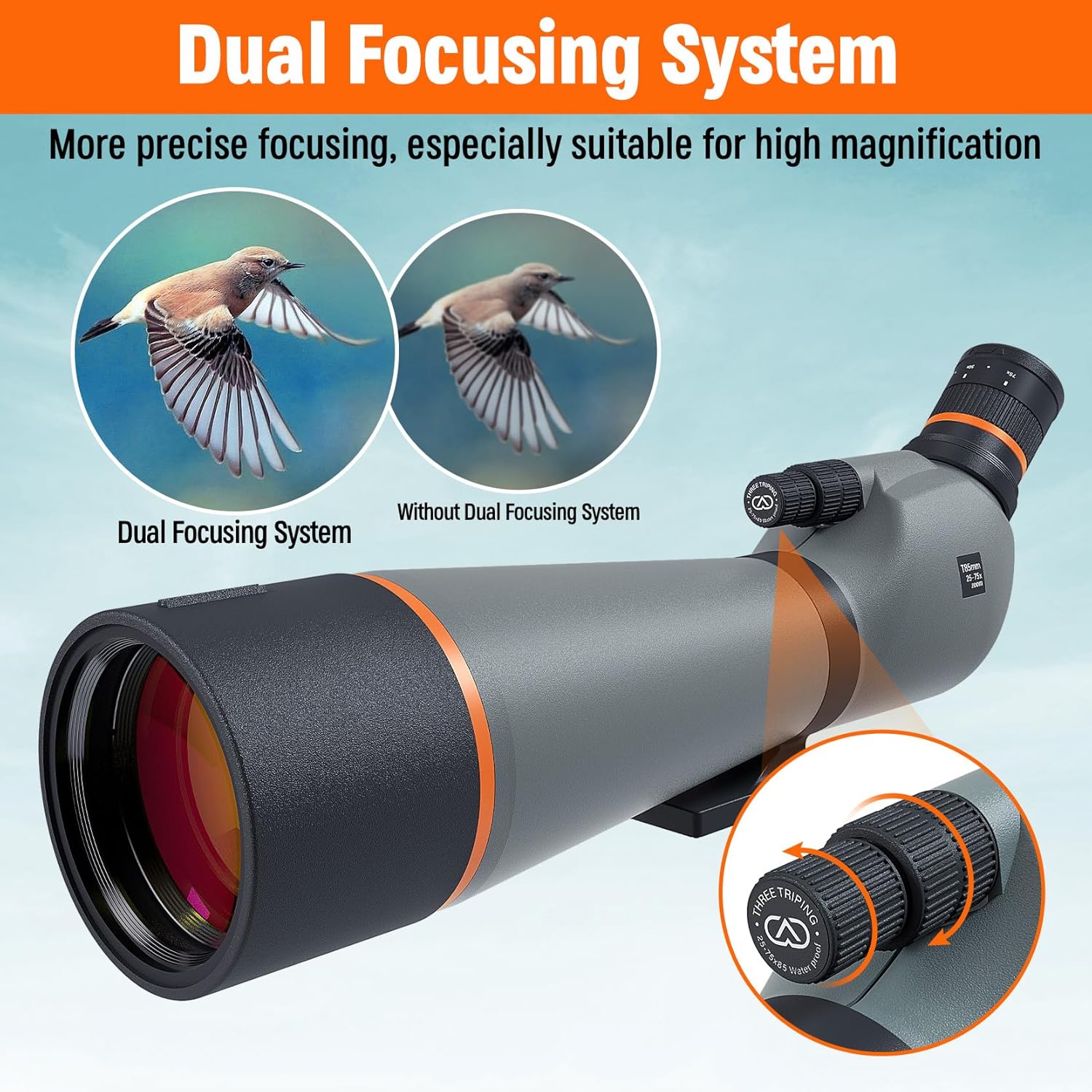
You’ll be able to pair your smartphone with the scope and capture images without buying a separate camera. The phone adapter is a modern necessity: it turns ephemeral observations into shareable, savable moments.
Getting a good digiscoped shot takes patience and alignment, but once you’ve nailed the geometry the results are unexpectedly satisfying. You can document behavior, confirm sightings, or simply send a shot to a friend that proves you weren’t imagining what you saw.
How to set up the phone adapter
You’ll attach the adapter to the eyepiece, align your phone’s camera lens with the ocular, and fine-tune for centering and focus. Start at low magnification, align, then increase zoom to avoid vignetting and edge distortion.
Keep your phone steady against the adapter; the difference between a usable photo and a blurry smear is often a matter of millimeters. Software can clean up exposure and contrast, but you still need optical alignment and physical steadiness.
Tips for better digiscoping photos
You’ll get clearer photos by using a timer or remote shutter to minimize shake when you press the screen. Lock your phone’s exposure and focus where possible so the camera doesn’t hunt as the scope’s fine focus changes.
Crop thoughtfully and resist the urge to over-zoom digitally. The scope provides optical magnification; digital zoom only amplifies noise and atmospheric shimmer.
Portability and carrying case
You’ll want a carrying case that’s tough enough to survive a car trunk and light enough to sling over a shoulder. The included case is purpose-built for travel: padded, organized, and able to hold the scope, tripod, and accessories.
Carrying isn’t just an afterthought; a case that’s easy to access means you’ll use the scope more frequently. You’ll be less likely to set it down and wander off without it.
Ease of transport for outdoor use
You’ll appreciate the case when you’re moving between vantage points or layering up for cold mornings. It keeps the kit together and reduces the temptation to leave bits behind in the mud or behind a bench.
The case also provides a quick shelter from unexpected rain, so you can at least move the scope to safety while you wait out a storm.
Protection and organization
You’ll find the inside pockets handy for the phone adapter, extra eyecaps, and a lens cloth. Organization matters when the light’s fading and you need to change configurations quickly.
The padding reduces risk of knocks and scrapes. It won’t make the scope indestructible, but it’ll lessen the days when you wince at a ding and worry about optical misalignment.
Use cases and real-world performance
You’ll want to know if this scope performs where you need it: birds, wildlife, target shooting, hunting, or archery. Each use case emphasizes different strengths, and this scope tries to be a generalist that still does specialist work well enough.
Below are situations where the scope shines and caveats you’ll want to keep in mind before committing.
Bird watching
You’ll enjoy the 25–75x range when watching birds; the lower power lets you find flocks, the higher power helps you study plumage. For small, fast birds you’ll need to favor the lower magnifications or pair the scope with deft panning and patience.
The clarity and coatings help bright and dim feathers resolve with color fidelity. If you mainly watch warblers in dense foliage, a binocular might still outpace a spotting scope for speed, but for perched raptors and distant shorebirds this spotter is a keeper.
Wildlife observation
You’ll use the scope to inspect antler racks, ear tags, or behaviors that require distance and discretion. The weatherproofing allows you to keep watching through misty mornings without rushing the gear back inside.
When animals are aware of you, range matters; this scope helps keep your distance and your moral compass intact.
Target shooting and archery
You’ll find the fine focus and high magnification useful for scoring arrows and bullets at distance. The scope’s clarity lets you see target rings and bullet holes without walking downrange prematurely.
Stability and shot-to-shot correction are what transform observations into improved scores. Pair the scope with a stable tripod and controlled breathing and you’ll cut down the time between spotting and adjustments.
Hunting and long-range spotting
You’ll appreciate the magnification to identify game and judge distance, but you’ll also need to balance weight and portability. If you expect to be mobile over rough terrain, test the kit in the field before a long hunt.
For glassing from a ridge or a vehicle-mounted blind, the scope offers a compelling mixture of power and clarity.
Travel and scenic observation
You’ll want a scope that can double as a travel optic when you’re at a coastline or a mountain overlook. This model’s included accessories and carrying case make it easier to bring along than buying separately.
You’ll trade some weight for performance, but for scenic observation and occasional wildlife viewing the payoff is real.
Durability and maintenance
You’ll keep the scope functional longer if you understand how to care for it: keep it dry, keep it clean, and handle the optics with respect. The protective features reduce risk, but nothing replaces a careful operator.
Carry a soft lens cloth, a small brush, and perhaps a sealed bag for rainy conditions. When the scope gets the kind of dirt that worries you, use a blower and a soft brush before touching the glass.
Cleaning the optics
You’ll avoid aggressive rubbing; it scratches coatings and introduces micro-abrasions that degrade image quality. Use a blower first, then a camel-hair brush or lens pen, and finish with a microfiber cloth in gentle circular motions.
Avoid household cleaners: use products designed for optics. A little care after each outing extends the lifespan of the coatings and keeps the view crisp.
Storage and long-term care
You’ll store the scope in its case in a dry, cool place and, if you can, remove it from sealed trunks where temperature swings are common. Keep caps on the objective and eyepiece to protect from dust and accidental knocks.
If you’re not using it for an extended period, a silica gel packet in the case will help prevent moisture buildup. The nitrogen purge is a safeguard, but prevention always beats repair.
Pros and cons
You’ll want a frank assessment before handing over cash. The pros and cons below are practical observations rooted in use and comparison, not marketing copy.
Pros:
- You get wide magnification flexibility from 25x to 75x, which covers most viewing needs.
- BAK-4 prism and FMC coatings deliver contrast and edge-to-edge clarity that feel premium for the price.
- Dual focusing gives you both speed and precision in focusing, which you’ll use constantly.
- The kit includes tripod, phone adapter, and carrying case, so you’re ready straight out of the box.
- Weatherproofing and nitrogen purge reduce fogging and moisture issues in the field.
Cons:
- At top magnification image stability depends heavily on tripod quality and calm air; shake and shimmer can be limiting.
- The included tripod is functional but not a professional-grade heavy-duty unit; windy conditions may push it past comfortable limits.
- The scope’s weight and size mean you’ll think twice before long-distance hikes with it strapped to your pack.
- Digiscoping takes practice to master; initial photos may be disappointing until you adjust alignment and settings.
You’ll find these pros and cons balanced toward utility. If you want the last word in ultra-high-end stability and glass, you’ll spend more. If you want a capable all-purpose spotting scope that behaves well in most conditions, this is persuasive.
Comparison with similar models
You’ll compare specs against popular models: 20–60×85, 30–90×88, and various fixed-power spotting scopes. The differences often come down to magnification extremes, objective size, and optical glass.
A 20–60x scope may be slightly lighter and more stable at top zooms, while a 30–90x model pushes detail further but amplifies atmospheric and stability problems. This 25–75×85 sits in the compromise sweet spot — wide enough for practical scanning, high enough for serious inspection.
Who the scope competes with
You’ll see this scope competing with mid-range spotting scopes targeting birders and shooters who want power without professional price tags. It’s a “do the job” scope with serious optical components like BAK-4 and FMC that punch above entry-level gear.
If you’re comparing on a budget, think about how often you’ll use top magnifications and whether you have room in your pack for a somewhat heavier optic. That context will guide whether this scope or a lighter model makes more sense.
Troubleshooting common issues
You’ll encounter a few predictable problems, and most are solvable without sending the scope back. Knowing the usual culprits keeps frustration low and observation time high.
If the image fogs internally, check seals and look for condensation; if it persists, the nitrogen purge might have been compromised and professional service is warranted. If the image is soft at edges, check eyepiece alignment and diopter settings before dialing blame on the prism.
Fixing shaky images
You’ll stabilize the tripod, add mass to its base, or switch to lower magnification when the air turns restless. Use a beanbag or rest the tripod legs against a stout object for extra steadiness.
Small adjustments in where you place your hands and how you breathe will also make an appreciable difference at high magnifications.
Handling focus issues
You’ll recalibrate the fine focus and ensure you’re not chasing focus while the target moves. Lock the coarse focus, then use the fine dial for micro-tuning.
If the scope refuses to focus at all, inspect the eyepiece and ensure nothing is obstructing movement; in rare cases a repair center will need to realign internal components.
Accessories worth adding
You’ll eventually want to augment the kit depending on how you use it: a heavier tripod for high magnification, a high-quality lens cap, or a spotting scope-specific case. You might add a sunshade extension for extra glare control or a remote for digiscoping.
A telephoto adapter for your phone can push digiscoping further, while a quality anti-reflection eyepiece cup improves comfort during long sessions. Think of accessories as tools to customize the scope to your habits.
Recommended tripod upgrade
You’ll consider a sturdier carbon-fiber or aluminum tripod if you use 60–75x frequently. The extra cost buys stability and less wind-sway, and that converts to more useful observation time.
Balance weight and strength for your typical outings; if you mostly sit in a blind, opt for heft; if you hike long miles, favor lighter but stable options.
Buying advice and who this is for
You’ll buy this scope if you want a flexible, well-equipped spotting scope that performs across many activities without demanding a professional budget. It’s a solid choice for birders, hunters, target shooters, and casual naturalists who value versatility.
If you’re a professional wildlife photographer or someone who relies daily on the absolute best optical performance, you may want something more tailored and expensive. Otherwise, this scope gives you a practical mix of features and accessories that make field use straightforward.
Should you buy it?
You’ll buy it if you value range, clarity, and a start-to-finish kit that includes tripod and phone adapter. The scope’s optical components and weatherproofing make it useful in real-world conditions where others would be waiting for better light.
You might pass if you need ultralight gear for long treks or if you demand maximum optical fidelity under every possible condition. For most people with wide interests, though, this is an efficient, thoughtful tool.
Final thoughts
You’ll find in the Spotting Scope 25-75×85, Dual Focusing Spotting Scopes with BAK4 Prism & FMC Lens, Tripod, Phone Adapter and Carrying Case, Spotter Scope for targeting, Bird Watching, Wildlife a device intent on usefulness. It’s not a showpiece, but it’s the sort of instrument that becomes familiar quickly and returns favors in the field.
You’ll learn its rhythms: what magnification to reach for, how to steady it, how to coax a clear digiscoped photo from a jittery hand. In exchange, it will show you details that alter your days — the feather pattern that confirms a species, the scoring hole you can analyze from the firing line, the silhouette that resolves into something worth keeping an eye on.
You’ll take it out with friends, you’ll argue about identification, you’ll trade photos, and you’ll eventually find that the best moments with optics are the ones they let you keep without having to move across the landscape to steal a look. This scope gives you that quiet power: the ability to stay put and still see more.

Disclosure: As an Amazon Associate, I earn from qualifying purchases.